
Scales of Measurement


example of interval scale

Variables can be split into categorical and continuous, and within these types there are different levels of measurement:

Categorical Variable:

Nominal Scale: In which data are neither measured nor ordered but subjects are merely allocated to distinct categories: For example, a record of students' course choices constitutes nominal data which could be correlated with school results.

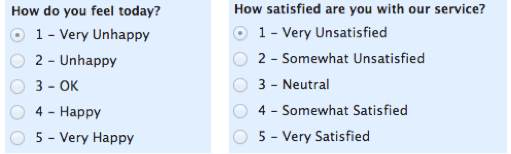
Examples of Nominal Scales

Ordinal Scale: A scale on which data is shown simply in order of magnitude since there is no standard of measurement of differences: for instance, a squash ladder is an ordinal scale since one can say only that one person is better than another.

Example of Ordinal Scales

Interval Scale: A interval scale has measurements where the difference between values is meaningful. In other words, the differences between points on the scale are measurable and exactly equal. For example, the difference between a 110 degrees F and 100 degrees F is the same difference as between 70 degrees F and 80 degrees F
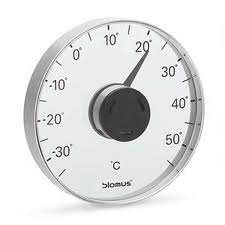
example of interval scale
Ratio Scale: A ratio scale is an interval scale in which distances are stated with respect to a rational zero rather than with respect to. A rational zero is a location on an interval scale deliberately chosen for reasons other than the current data.
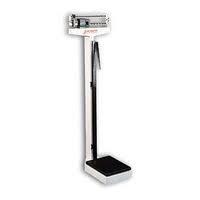
Example of Ratio Scales


Comments

Popular posts from this blog

Frequency Distribution and Data Presentation

A  frequency distribution is a table that displays the frequency of various outcomes in a sample. Each entry in the table contains the frequency or count of the occurrences of values within a particular group or interval, and in this way, the table summarizes the distribution of values in the sample. Organizing Data. 1.Arrange data into an array 2. Decide on the number of classes( k) 3. Calculate the class interval 4. Prepare a tally sheet There are two types of Frequency:  Categorical frequency distribution. Grouped frequency distribution. Categorical Frequency Distributions The categorical frequency distribution is used for data that can be placed in specific categories or represent values of a qualitative variable. Grouped Frequency Distributions: When the data are numerical and their range is large, the data must be grouped into classes that are more than one unit in length. Histogram The histogram is an accurate graphical representati...

Hypothesis Testing

Hypothesis refers means an educated guess or an assumption that can be tested. Forms of hypothesis: 1.       HA- Research hypothesis 2.       HO- Null hypothesis HA: Research hypothesis: The research hypothesis is also known as an alternate hypothesis. HA is a statement on which a statistical hypothesis test is set up. HO- Null hypothesis: Null hypothesis is also known as no difference or no relationship, this is used to facilitate testing of research hypothesis Types of hypothesis: ·         One-tailed- Directional HA: p>0 HO: p<0 ·         Two-tailed- non-directional HA: p not equal to zero Types of Error: Type 1 Error – Rejection of a true Null hypothesis. Type 2 Error – It may have a false negative finding. Type 1 error is donated by Alpha. Level of significant can reduce...

Population and Sample

A Population comprises of all elements showing the parameters of an individual or objects. Whereas, a Sample is a sub-set of a population showing statistics.